
Helping emerging musicians build a career takes more than great music—it requires meaningful opportunities to connect, collaborate, and be discovered.
Partnering directly with the Leep Audio team, our multidisciplinary UX/UI design team expanded their existing platform by designing two new experiences: a Collaboration space where artists can find creative partners and work together, and a Competitions experience that encourages talent discovery, community engagement, and prize-based challenges.
From research and user flows to wireframes and visual design, we created scalable solutions that strengthened the product while laying the foundation for future growth.
Learning from adjacent industries
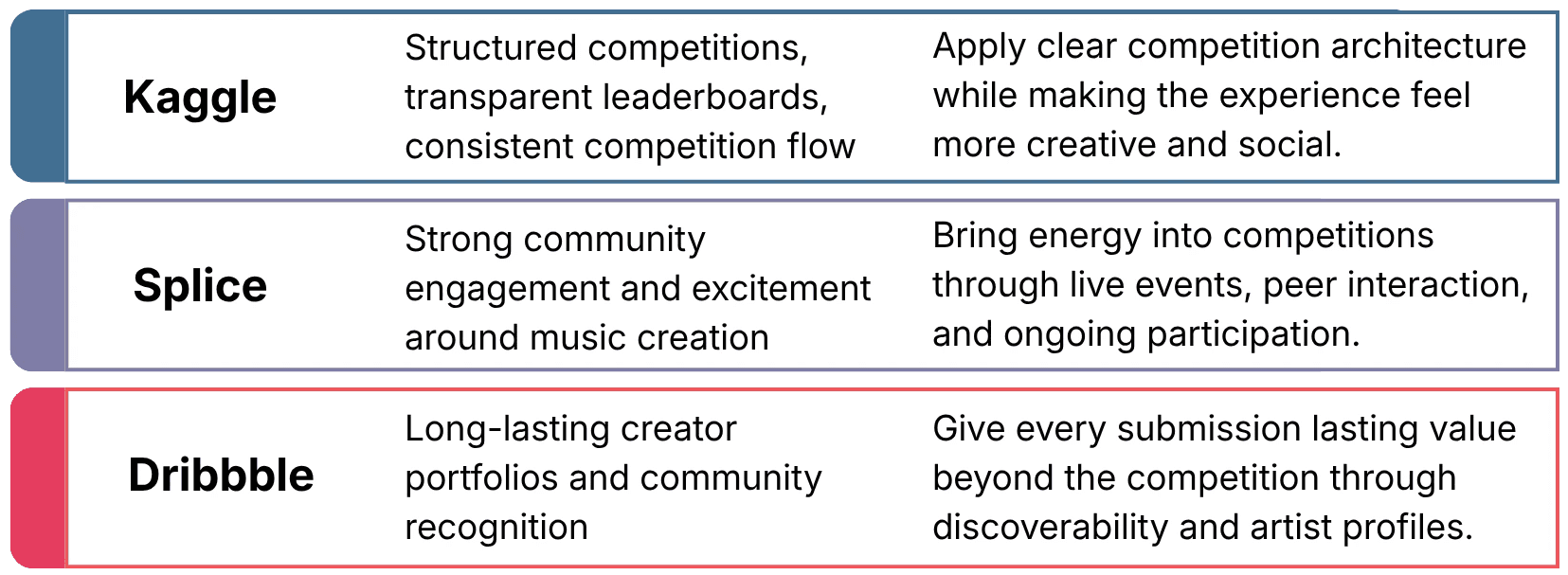
Rather than looking solely at music platforms, I conducted a Competitive Analysis, and analyzed products that excel at competitions, creative communities, and collaboration.
Each platform solved a different piece of the problem, revealing opportunities for LEEP Audio to create a more engaging competition experience.
Key Research Insights
Competitions should feel like events — Build anticipation before, during, and after submission, not simply around announcing winners.
Every submission should have lasting value — Entries should strengthen an artist’s portfolio and exposure even when they do not win.
Community participation drives engagement — Voting, commenting, and sharing turn listeners into active participants.
Clear structure builds confidence — Transparent rules, progress tracking, and consistent layouts make participation feel approachable.
Design Opportunity
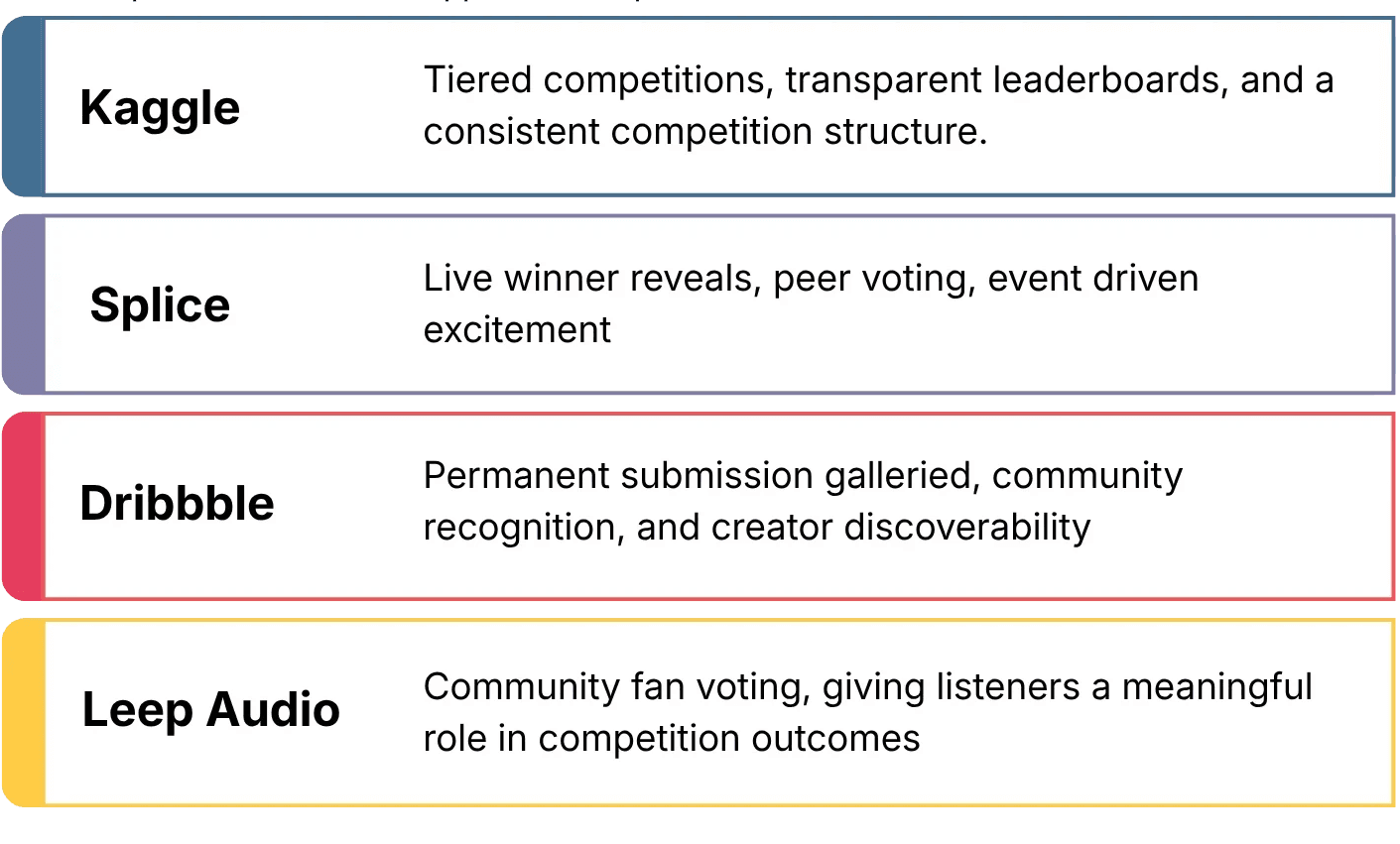
What LEEP could uniquely combine: instead of copying a single competitor, we combined the strongest qualities from each platform to create a distinctly music-first experience.
Feature Inspiration & Application
Final Design Principles
Structured but approachable competition flow
Competitions that remain valuable after they end
Community participation throughout the experience
Transparent judging and live results
Music-first interactions that strengthen relationships between artists and fans
To define the direction we needed to take, I created a HMW question to ensure the team was aligned with our goals.

Our next step- Solving the problem
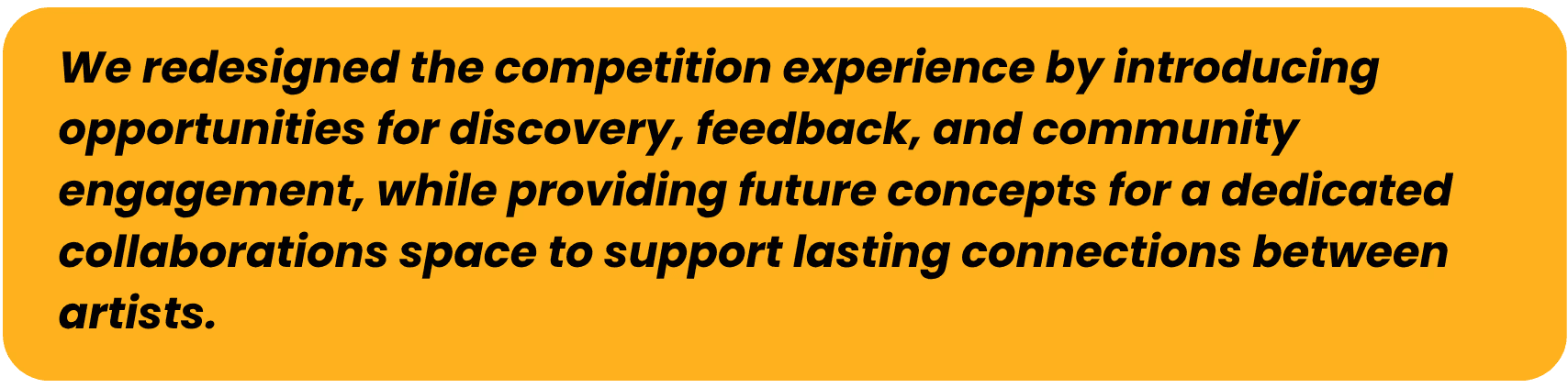
To demonstrate how insights from the competitive analysis could translate into LEEP's product, I created a sitemap that explored multiple competition models and user journeys.
This helped the client visualize how different competition structures could be integrated into the existing platform while supporting both their immediate MVP goals and long-term vision.
Instead of treating competitions as standalone moments, we reimagined them as a gateway into the LEEP community. The redesigned experience promoted discovery, meaningful engagement, and ongoing collaboration, while delivering an MVP that could seamlessly support the platform's future expansion.
Instead of treating competitions as standalone moments, we reimagined them as a gateway into the LEEP community. The redesigned experience promoted discovery, meaningful engagement, and ongoing collaboration, while delivering an MVP that could seamlessly support the platform's future expansion.
The overall user flows were developed collaboratively by the team to define the core journeys through the Competitions experience. My role built on this foundation, translating these flows into intuitive screen designs that supported a seamless experience from discovery and participation through to competition completion.
Bringing the Product to Life:
With the overall structure of the site decided and agreed upon, the team began designing the lo-fidelity frames, giving the client a visual representation of how their site would come together, and an opportunity to iron out any kinks that might appear along the way.
The client informed us that they would be user Loveable to build their site, relying completely on AI for coding and programming.
With this is mind, we knew we needed to present pixel-perfect designs, as well as create flows that would easily translate across multiple pages, streamlining the programming process.
In order to meet a demand for a high volume of work on a tight deadline, the team and I utilized Claude as a tool to help us bring our vision to life in the lo-fidelity stage, before bringing the frames into Figma and applying our own designs for the Hi-Fidelity deliverables.
I was responsible for designing the lo-fidelity wireframes for the "Site Walkthrough" - giving new users a tutorial of the site, and ensuring ease of use.
Click through to see the full album of Lo-Fi Screens:
After presenting our Lo-Fi screens to the client, 3 key takeaways were uncovered:

Despite joining the project mid-production, the client gave our team free reign to redesign the screens to fit our needs, with the intention that new design systems would then be implemented across the rest of the site.
The client wanted to ensure the site looked clean, futuristic and colourful. We put together the following design system, and with approval from the client, applied it to the hi-fidelity wireframes.


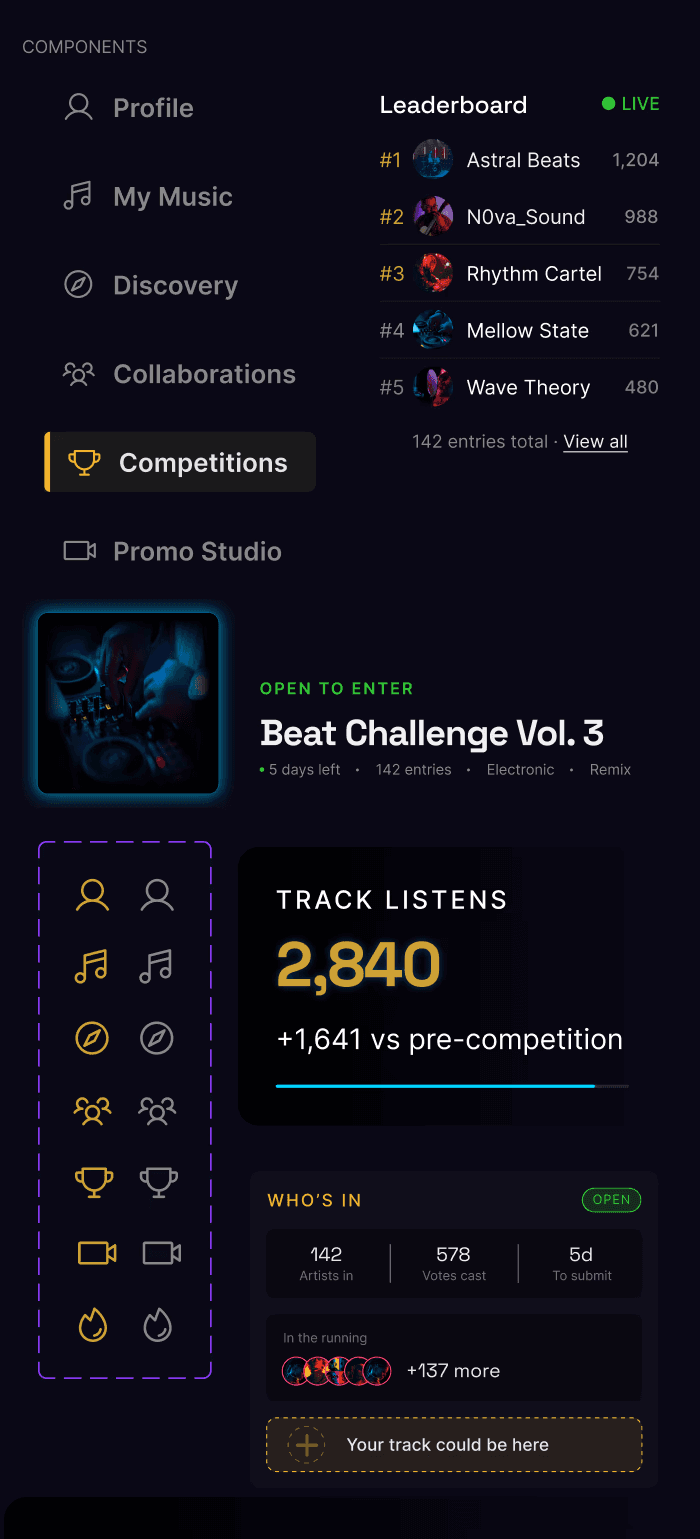
After getting the green light on the visual direction, we created a full component library- a critical step to ensuring a smooth transition through Loveable, and set out to create our high fidelity wireframes.
I was responsible for designing the Submissions page in high fidelity, translating the team's concepts into a polished interface. This screen allows users to browse and listen to competition entries—a key interaction that unlocks voting privileges while helping artists gain exposure and attract new fans.
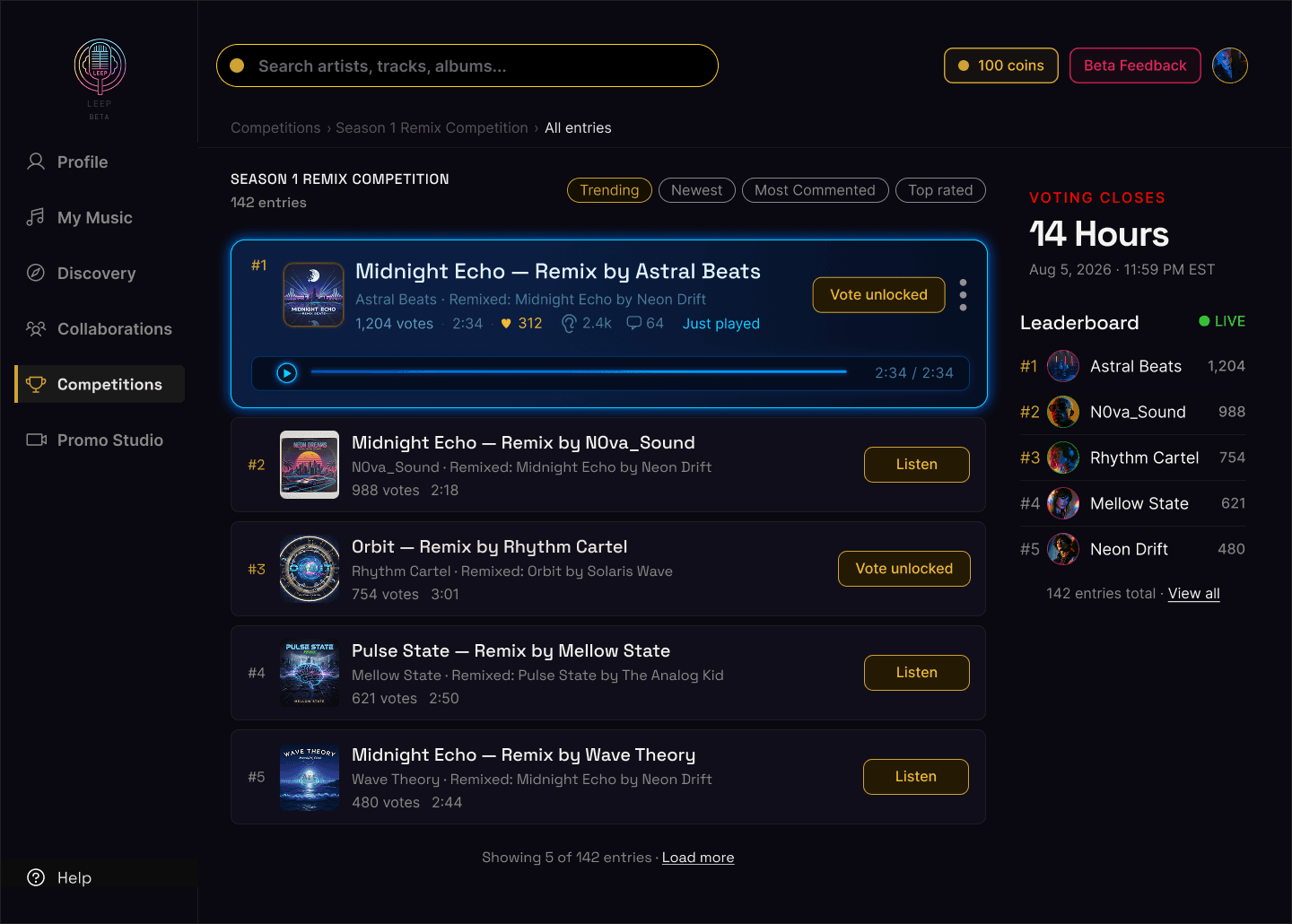
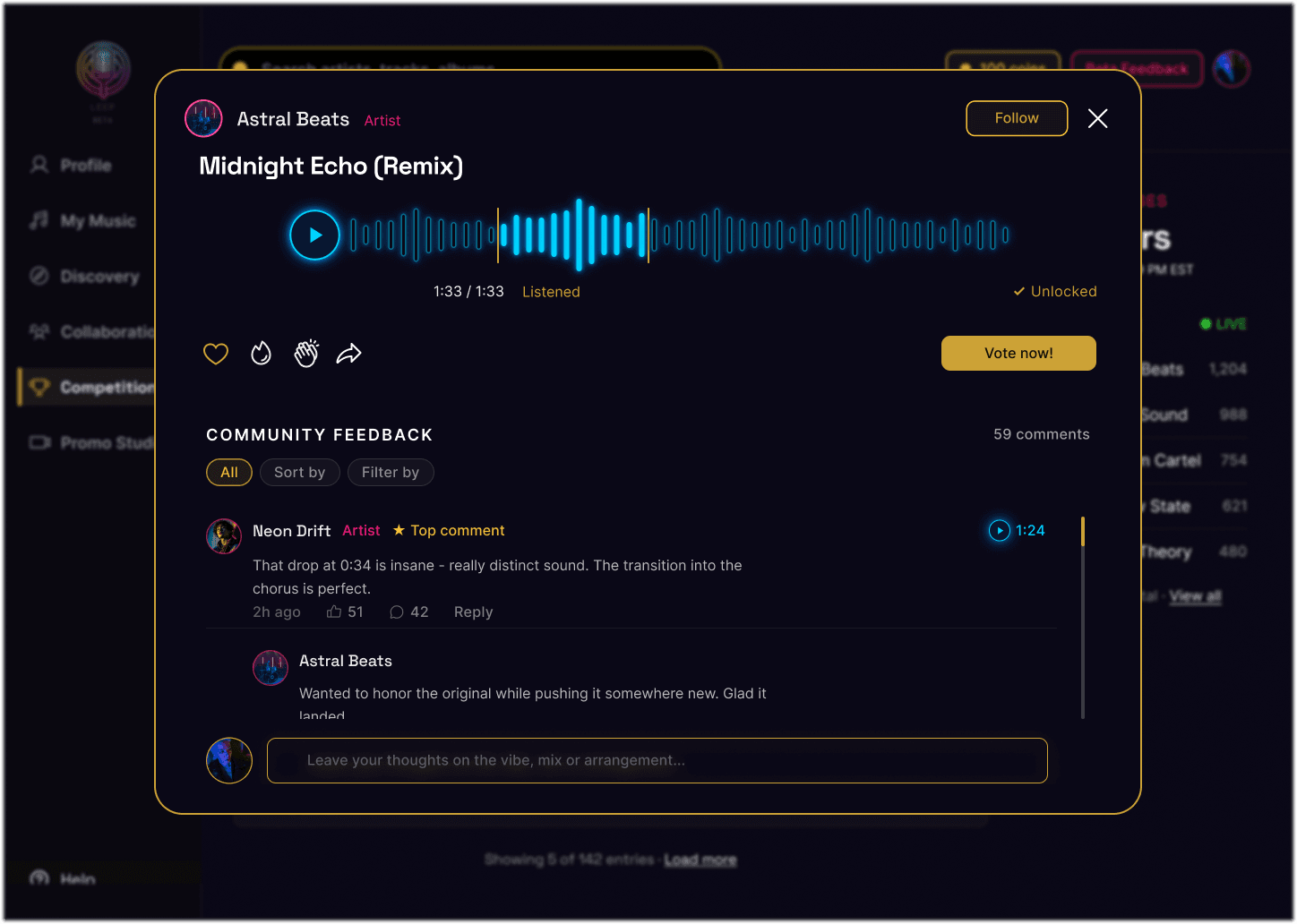


The final solution reimagines competitions as an ongoing community experience rather than one-time events. Artists can discover opportunities, submit entries, vote, receive feedback, and stay connected with the community beyond the competition lifecycle.
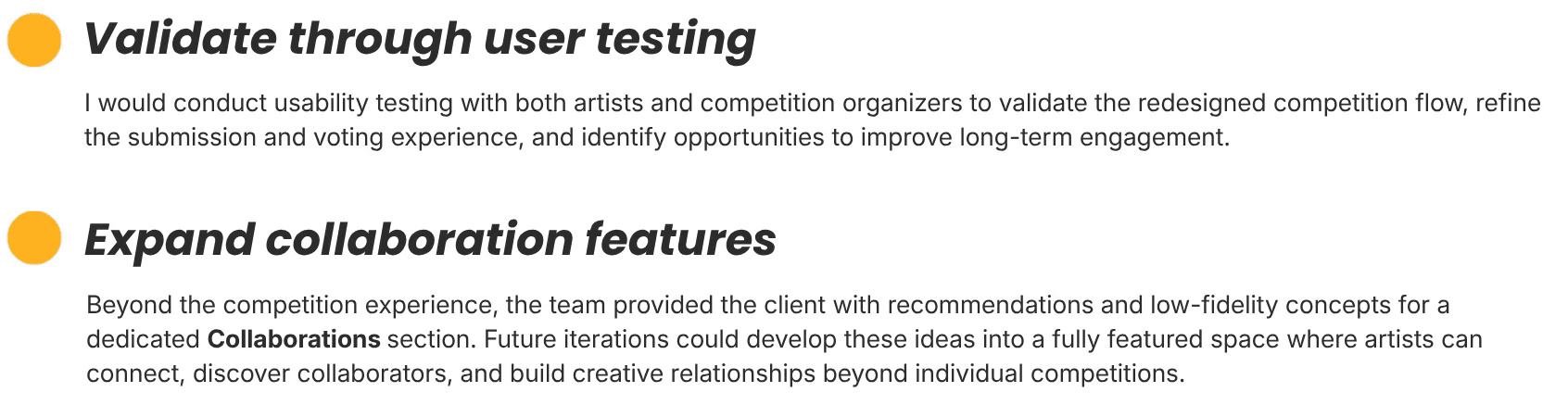
The project also laid the groundwork for future collaboration features, creating a scalable platform that supports artist discovery, growth, and long-term engagement.
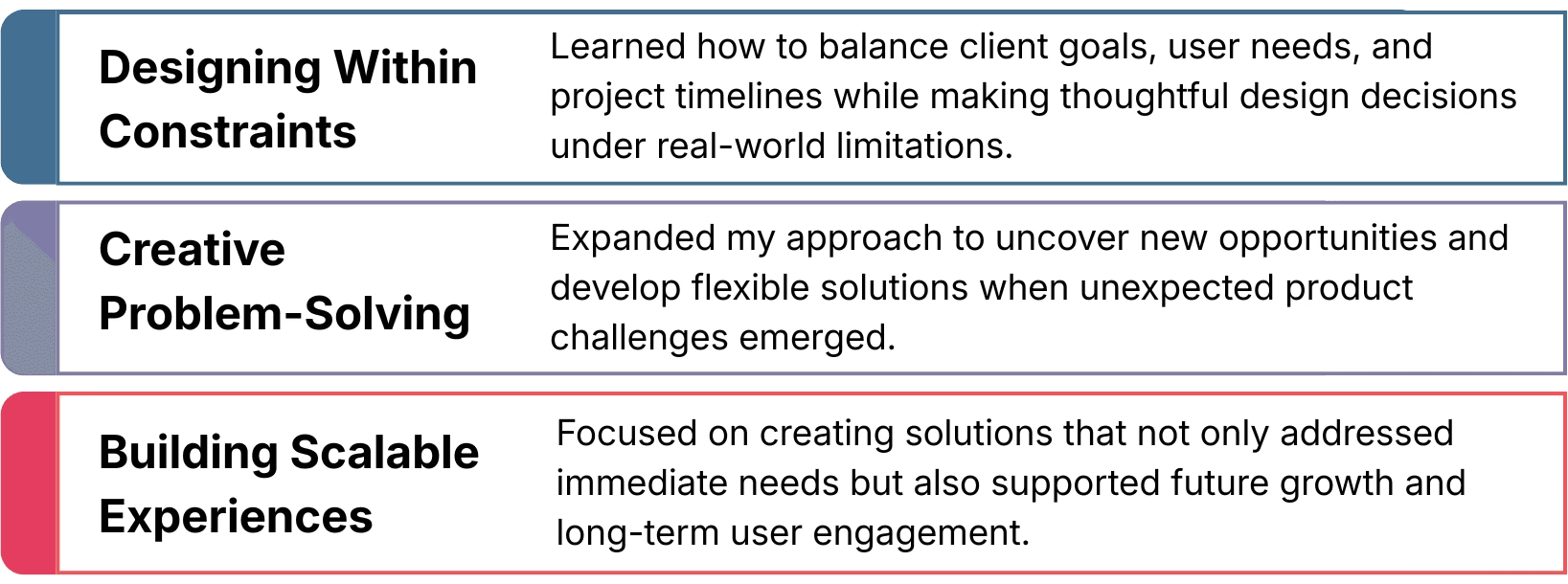
This project strengthened my ability to design within real-world constraints while balancing user needs, business goals, and client expectations. Working with Leep challenged me to translate a broad vision into a focused product experience that addressed specific client requirements while staying within a defined timeline.
Throughout the process, I learned the importance of adaptability and creative problem-solving when unexpected product challenges arise. Rather than viewing constraints as limitations, I expanded my thinking to explore new possibilities and develop solutions that supported both artists and the platform’s long-term goals.
Most importantly, this project reinforced the value of designing with intention — understanding the needs behind each request, making thoughtful trade-offs, and creating experiences that are not only visually engaging but also meaningful and scalable for real users.
"Everyone worked in a timly manner and really came together to produce a wonderful result. Even when asked to adjust few things with in the little time they had they went above and beyond very happy how this came out"
Leep Audio
CEO