SettleWell is a mobile app designed to help users navigate the challenges of settling into a new place by transforming a complex, often stressful experience into a clearer, more supportive journey. Through user-centered research and thoughtful interaction design, I created an experience that prioritizes clarity, accessibility, and emotional reassurance—helping users stay organized, informed, and empowered during times of transition.
The result is a validated app that gives families support, insight and connection, while navigating the stressful experiences involved in relocation. The prototype showcases three core flows: Onboarding, creating a profile, and adding events to the calendar feature—creating an experience that empowers parents and keeps families organized.
Relocating is one of life's most stressful experiences, but for families, the challenge extends far beyond packing and logistics. Parents must navigate unfamiliar schools, healthcare systems, community resources, and daily routines while helping their children adjust emotionally to an entirely new environment.
Many relocation tools focus on the move itself, but our research revealed that the biggest challenge begins after moving day. Families weren't just looking for information—they needed a way to build confidence, establish routines, and feel connected to their new community. Existing resources were often fragmented across websites, social media groups, and word of mouth, leaving parents overwhelmed and unsure where to start.

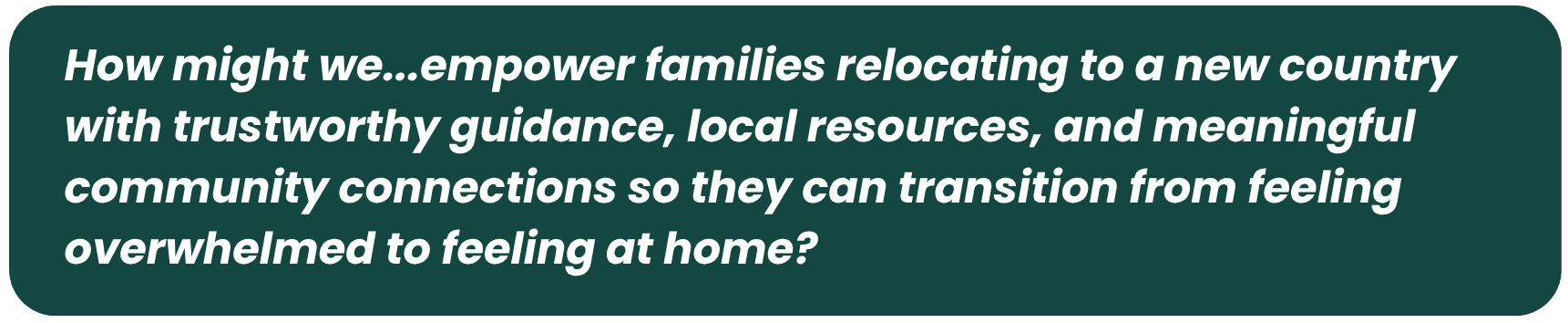
So, how might we design an experience that supports families beyond the move, helping them transition from simply relocating to truly feeling at home?
With a question in my mind, I set out in search of answers.
I began with a competitive analysis -looking at what products were being offered, and where user needs were, or were not, being met. I gathered this information in hopes of pinpointing issues within the current product experiences for both families, with a focus on usability and trust.
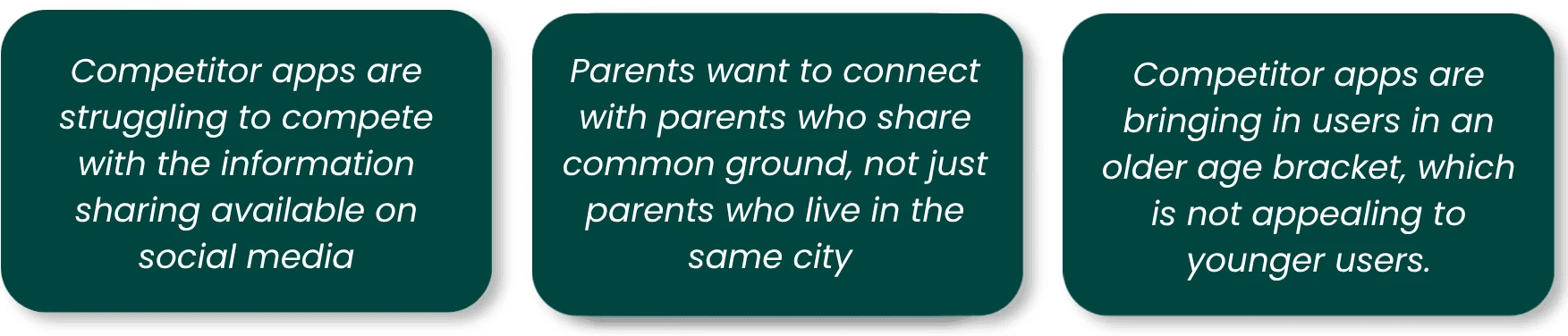
Throughout my competitive analysis, where I researched companies such as OneRoof, NextDoor, City Socializer and Move Advisor, some key findings stood in helping me identify gaps in the market:
Next, I conducted a set of research interviews, looking to gain more information key user groups- Parents who recently relocated with their families.
I interviewed 4 potential users:
Monica- Wife and Mom of one, relocated 1 year ago
Ma’ayan- Wife and Mom of two, relocated 2 years ago
James- Husband and Dad of two, relocated 6 months ago
Leah- Wife and Mom of two, relocated 6 months ago
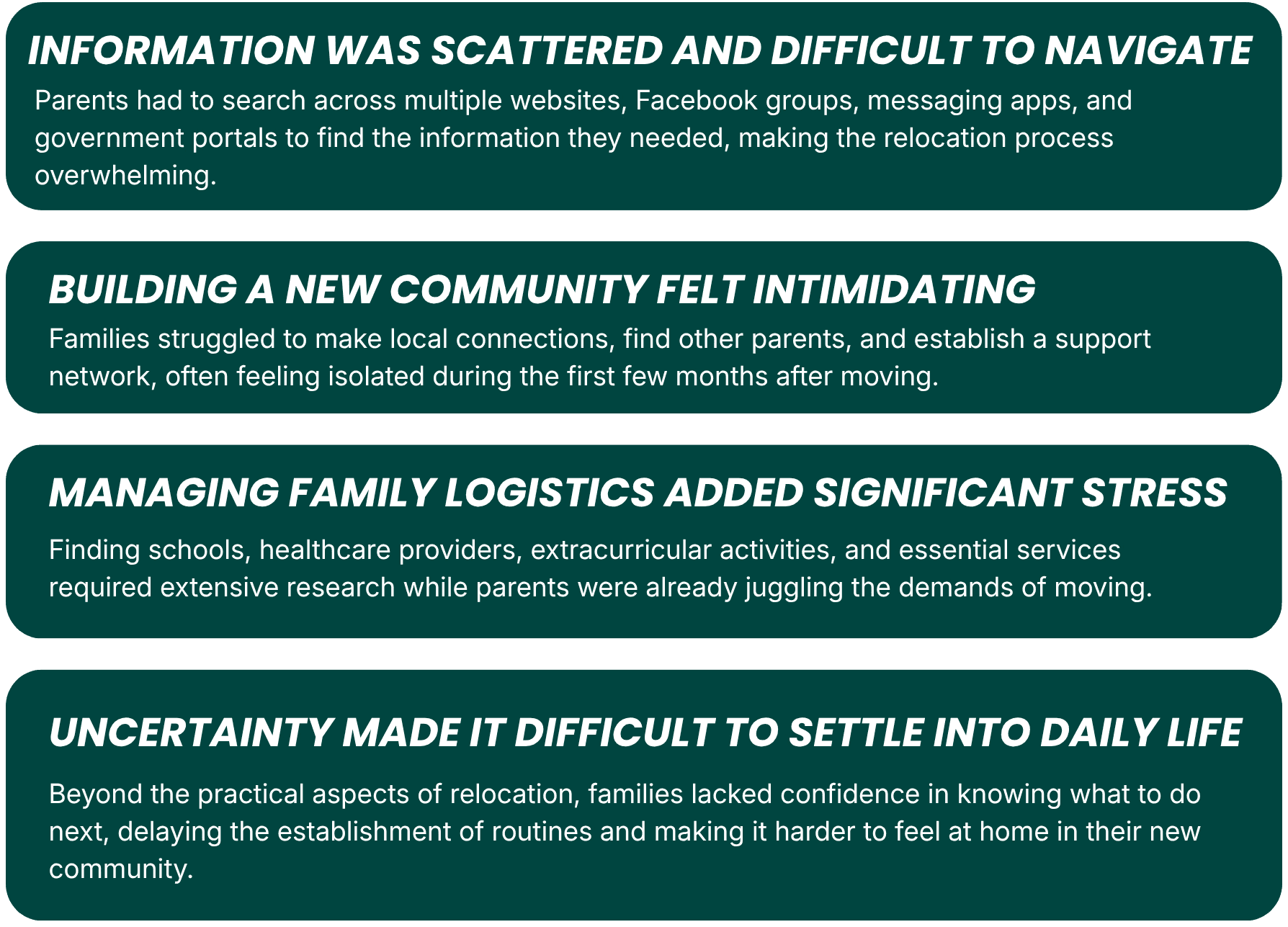
4 key patterns emerged across the interviews:
After identifying the challenges participants faced throughout the relocation process, I synthesized the interview data using an affinity map. Organizing quotes, observations, and pain points into thematic groups allowed me to uncover recurring patterns across families’ experiences rather than focusing on individual users.
To uncover meaningful patterns across our research, I synthesized insights from six interviews using affinity mapping. Grouping participants' experiences into themes revealed that the greatest challenges extended beyond the move itself: families struggled with fragmented information, navigating schools and local bureaucracy, overcoming language barriers, and building new community connections. These insights helped identify the core opportunities that ultimately shaped the direction and feature set of SettleWell.

While each family’s journey was unique, these themes highlighted shared frustrations and opportunities where a digital solution could provide meaningful support.
Another key topic that surfaced through the affinity mapping, was the concerns of parents who have children with exceptional needs. Whether related to schooling, socialization, or accessibility needs, families with exceptional needs felt left out of existing systems, seeking new ways of finding support.
These insights became the foundation for SettleWell’s feature set, ensuring that every design decision addressed validated user needs rather than assumptions.
The research brought forward three distinct personas, which I crafted to help guide my design choices. Knowing that every family will be entering into the relocation process with their own unique needs, I wanted to ensure that my personas covered a broad variety of family types, addressing the individual needs of each one.

Throughout my interview process one main issue presented itself - 3/5 of the parents I interviewed had neurodivergent children. While I didn't want to shift the focus of SettleWell to be exclusively aimed at neurodivergent families, I did take steps to ensure SettleWell would serve their unique needs as well.
This lead me to a question:
My next step- solving the problem.
I built a site map to help determine what features were needed, and tested the maps on potential users, iterating on feedback to ensure the site would be built in the most organic way for our user base.
Having solved the issue of integration, I drafted user flows and task flows for our user types, plotting out the journey our users will take for each of the tasks being built for user testing.
I had my direction in mind, but what was it going to look like?
When I thought about what I wanted SettleWell to represent and convey, three words stuck out:
Safety
Community
Support
With these key words in mind, I thoroughly researched the design systems used for other brands that shared the same values.
I found a lot of inspiration not from relocation apps, but instead in parent support and education spaces.
I created a mood board, and pulled the common features that these brands shared- calm, inviting colours, soft, rounded edges, and clear, easy to read fonts.


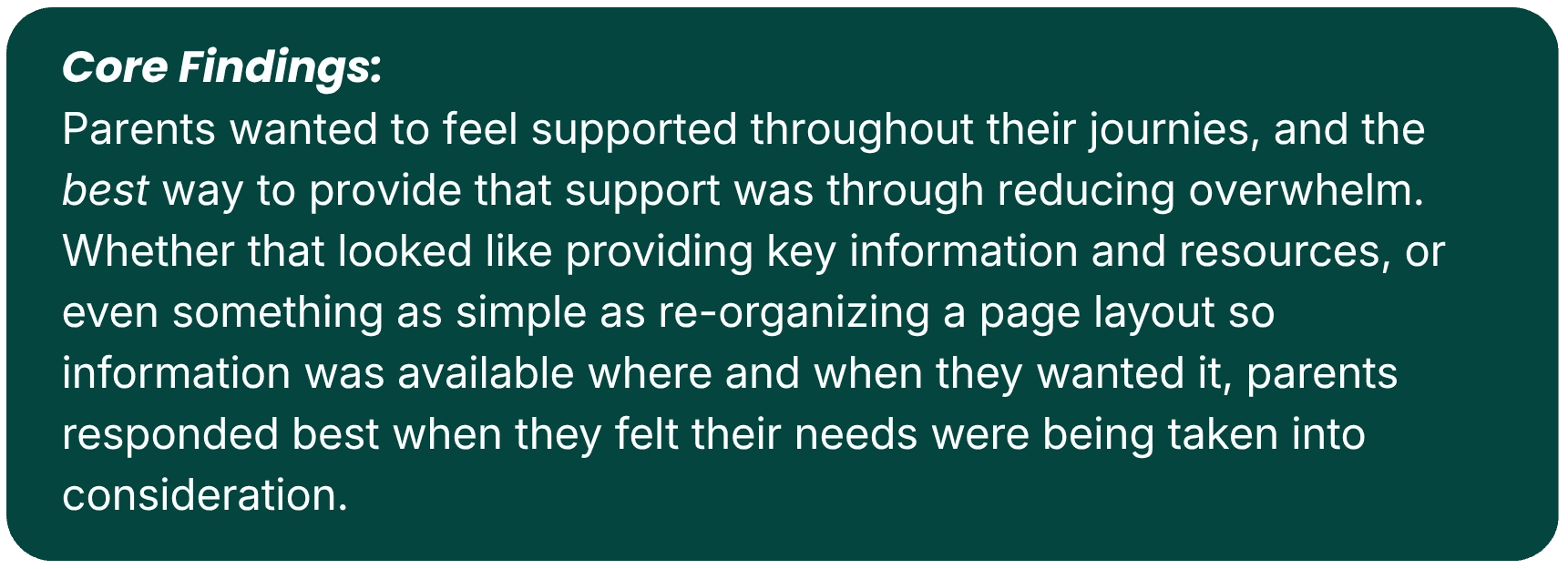
Usability testing was carried out twice- As a low-fidelity, low stakes test, and as a Hi-Fidelity test.
5 main pain points were identified, 2 critical.



While the current iteration of SettleWell meets many of my initial goals and user needs, time constraints meant that some ideas uncovered during research and usability testing have been reserved as future enhancements.